


In a decision that has captured the attention of businesses and creators across Kenya, the High Court in Nairobi has overturned a previous judgment that had awarded media personality Willis Raburu a significant sum of money from telecom giant Airtel. The case, revolving around the ownership of the slang word “Bazu,” offers a crucial lesson on the limits of trademark protection and the fundamental importance of a court’s legal authority.
The Core of the Dispute
The legal battle began when Willis Raburu sued Airtel Kenya. He claimed that the company’s use of the word “Bazu” to promote its internet data bundles infringed upon a trademark he had officially registered. Raburu held the trademark for “Bazu” in several classes related to advertising, business, and telecommunications services.
In the initial case, a Magistrate’s Court agreed with Raburu. The court ruled that Airtel had indeed infringed on his trademark rights and ordered the company to pay him 6.5 million Kenyan shillings in damages and to permanently stop using the word.
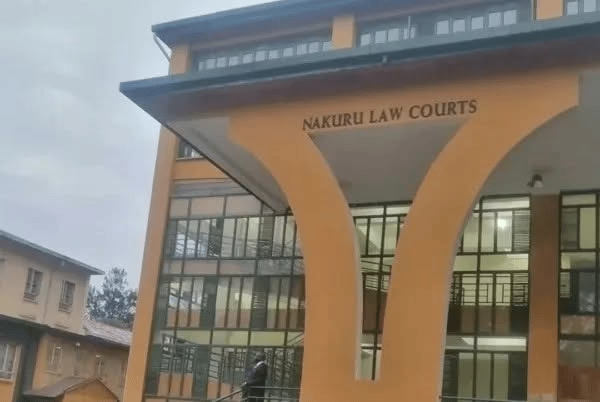
Airtel, disagreeing with this outcome, took the matter to the High Court. Their appeal was not primarily about whether they had copied the word, but about something more foundational: whether the Magistrate’s Court had any legal right to hear a trademark case in the first place.
The High Court’s Groundbreaking Decision
The High Court’s judgment, delivered by Justice L. P. Kassan, focused on a single, powerful legal principle: jurisdiction. Jurisdiction is the official power a court has to make legal decisions and judgments. The court declared that “jurisdiction is everything,” and without it, a court’s proceedings are a nullity.
Why the Lower Court Lacked Power
The High Court’s analysis was straightforward. It looked at the Kenya Trademarks Act, the very law that governs all trademark matters. The Act explicitly defines the word “court” as meaning only one thing: the High Court. The law does not grant Magistrate’s Courts the authority to adjudicate disputes about trademark infringement.
The fact that the case had been transferred from the High Court to the Magistrate’s Court for trial did not change this legal reality. A court cannot gain power through an administrative transfer if the underlying law does not grant it that power. Since the Magistrate’s Court never had the legal authority to rule on the trademark issue, its entire judgment, including the award of 6.5 million shillings to Raburu, was invalid. The High Court set it aside entirely and ordered that the original case be struck out.
Implications of the Ruling
This ruling has several important consequences that extend far beyond the two parties involved.
First, it serves as a stark reminder that legal technicalities can be just as important as the facts of a case. Airtel won its appeal not by proving it didn’t infringe, but by successfully arguing that the case was heard in the wrong venue.
Second, it clarifies the pathway for future trademark disputes in Kenya. Anyone wishing to sue for trademark infringement must now file their case directly in the High Court. Magistrate’s Courts are not an option for such claims, regardless of the monetary value involved.
Finally, the judgment leaves open the substantive question of whether a common slang word like “Bazu” can be exclusively owned through trademark registration. While the High Court did not rule on this issue, Airtel had argued strongly that “Bazu” is a generic term in Sheng, meaning “plenty” or “a lot,” and is therefore not something one person can monopolize for business. This question of generic terms versus protectable trademarks remains a live wire for future litigation.






Leave a Reply