


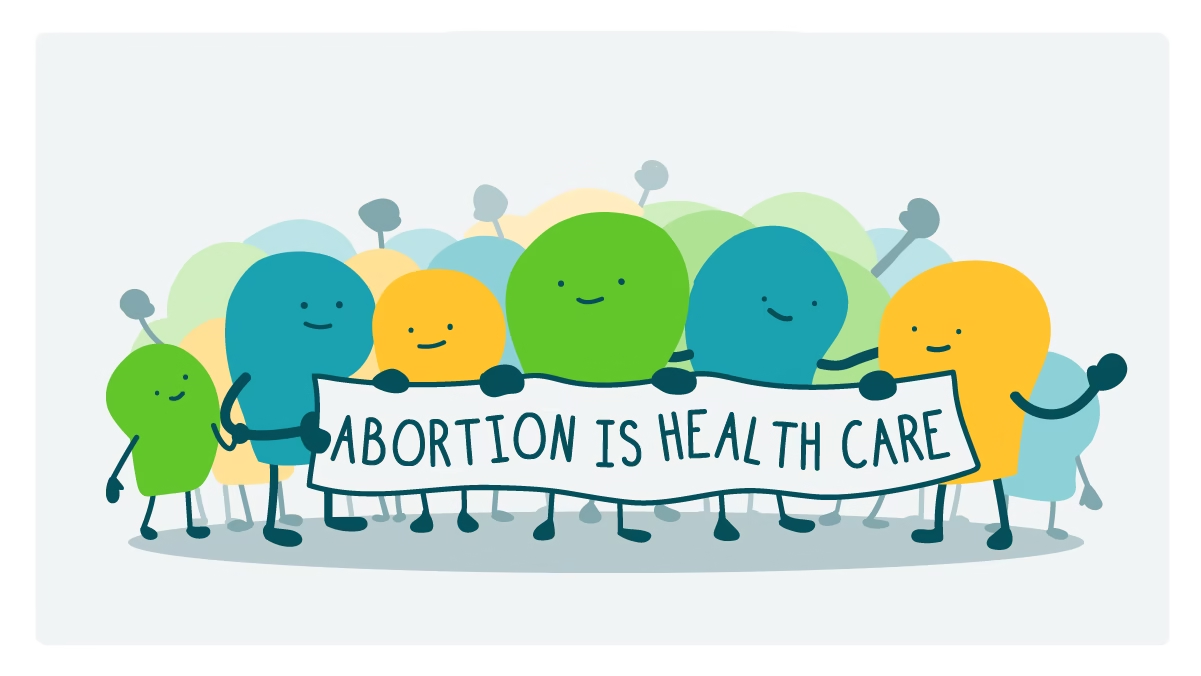
For months, the legal and human rights corridors in Kenya have been buzzing with a singular question: Where does the law draw the line between a medical emergency and a criminal act? In a groundbreaking and emotionally charged ruling delivered at the Court of Appeal in Malindi, the scales of justice have shifted once again in the case of PAK, a minor, and Salim Mohamed, the trained medic who treated her.
At Legal Express Kenya, we dive into the heart of this ruling, a case that isn’t just about statutes and sections, but about the very definition of life, privacy, and the power of the state.
The Day the Clinic Became a Crime Scene
The story began on a painful Tuesday in September 2019. PAK, then a 17-year-old student, arrived at Chamalo Medical Clinic in Kilifi. She was in agony, experiencing severe abdominal pain, dizziness, and heavy bleeding. Salim Mohamed, the medic on duty, diagnosed her with an “incomplete abortion”, a medical term for a miscarriage that hasn’t fully cleared. He did what any trained professional would: he provided emergency post-abortion care (PAC) to save her life.
But two days later, the recovery room turned into a interrogation room. Police stormed the clinic, confiscated medical notes, and arrested both the bleeding teenager from her hospital bed and the man who treated her.
PAK was charged with procuring an abortion, while Mohamed faced charges for “unlawfully administering drugs” to cause a miscarriage.
The High Court’s Bold “Shield”
In 2022, High Court Judge Reuben Nyakundi issued a landmark judgment that sent shockwaves through the conservative and liberal blocks alike. He didn’t just stop the prosecution; he declared that:
- The arrest of a patient seeking emergency care was “cruel, inhuman, and degrading treatment”.
- Forcing a medical examination on the minor violated her right to privacy and dignity.
- Most controversially: He described the right to abortion as a “fundamental right,” albeit one limited by the Constitution.
For a moment, it seemed the High Court had created a legal sanctuary for reproductive health. But the state, joined by the Kenya Christian Professionals Forum, wasn’t backing down.
The Reversal: The Court of Appeal’s Hard Line
On April 24, 2026, the Court of Appeal (Judges Gatembu, Laibuta, and Ngenye) dismantled that shield. In a 44-page judgment, the court set aside Justice Nyakundi’s ruling. CIVIL APPEAL NO. E029 OF 2022
The core of their decision? The High Court jumped the gun.
The appellate judges ruled that the constitutional petition was “premature”. They argued that the truth, whether PAK had a natural miscarriage or an induced abortion, can only be determined through a full criminal trial, not a constitutional side-suit.
What this means now:
- Charges Reinstated: The criminal cases against PAK and Salim Mohamed are officially back on.
- Trial to Proceed: They must now present their defense in the Senior Principal Magistrate’s Court at Kilifi.
- A Narrower Lens: The court leaned toward a “restrictive approach,” noting that while Article 26(4) allows exceptions (like saving the mother’s life), the foundation of Kenyan law remains the “right to life from the moment of conception”.
Why This Matters to You
This case is a legal lightning rod. On one side, groups like KELIN and FIDA-Kenya argue that criminalizing these services drives women to back-alley clinics, increasing maternal deaths. On the other, the Attorney General and religious forums argue that the Penal Code (Sections 158-160) remains a necessary guardrail for the unborn.
For the “common mwananchi,” the message is chillingly unclear: Can you trust your doctor? Can a doctor trust the law?
The Legal Express Review
This ruling is a reminder that in Kenya, the Constitution is a living, breathing, and often conflicting document. While the Court of Appeal focused on procedural order, the human cost is heavy. A young girl, once a student seeking help, is back in the dock. A medic, once providing care, is back in the crosshairs.
As we wait for the Kilifi Magistrate’s Court to hear the merits of Case No. 395 and 396, one thing is certain: the debate over Article 26(4) is far from over.
What do you think? Should medical emergencies be immune from police interference, or is a trial the only way to find the truth? Stay tuned to Legal Express Kenya for the latest updates on this landmark case.













Leave a Reply