


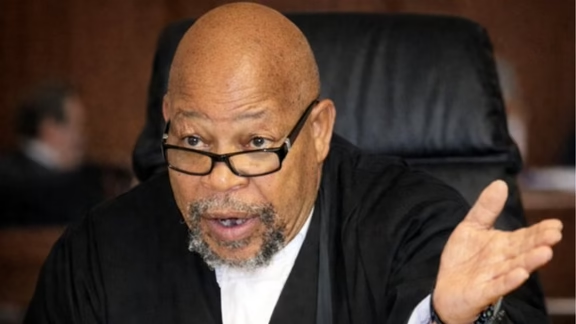
There are cases that quietly pass through the corridors of justice, and then there are cases that force the legal community to pause, reflect, and ask uncomfortable questions.
This is one of them.
In Justice Tseliso Monapathi v His Lordship The Chief Justice & 4 Others (CONST CASE No. 17/2025) [2026] LSHC 10, the Constitutional Division of the High Court of Lesotho was confronted with a question as old as justice itself, but framed in a way few had seen before:
Can a judge walk away from unfinished justice, and still demand to be paid for it?
The Backstory, When Justice Waits, and Waits, and Waits
Justice Tseliso Monapathi retired in August 2024 at the constitutional age of 75. That, in itself, is routine. What was not routine was what he left behind:
- 128 undelivered judgments
- 11 part-heard cases
- Some matters dating back nearly three decades
Let that sink in.
Cases filed in the mid-1990s, still waiting for closure.
Litigants who had come to court in search of justice, left in a legal limbo.
And then came the administrative decision that triggered this constitutional showdown.
The Chief Justice directed that Monapathi must complete all pending judgments before accessing his pension benefits.
Monapathi pushed back.
And just like that, a personal dispute became a constitutional moment.
The Legal Question, Is “May” Optional, or Mandatory?
At the heart of the case lay a deceptively simple provision of Lesotho’s Constitution:
A judge “may” continue in office after retirement to deliver pending judgments.
Now, in ordinary language, “may” suggests discretion, choice, freedom.
Monapathi’s argument leaned heavily on this:
- He had retired
- He could choose whether or not to continue working
- His pension was a right, not a privilege to be withheld
But the Court was not persuaded.
Because in law, context is everything.
The Court’s Reasoning, When Words Meet Purpose
The Court took a step back and asked a broader question:
What would happen if “may” truly meant optional?
The answer, in the Court’s own logic, was troubling.
It would mean:
- Judges could retire and abandon unfinished cases
- Litigants could wait indefinitely
- Justice could simply disappear
And that, the Court said, would be absurd.
So it did what courts often do when faced with ambiguity, it looked beyond the word, into the purpose.
“May”, in this context, was interpreted to mean a duty, an obligation, a constitutional responsibility.
Not a choice.
Accountability vs Independence, Where Do We Draw the Line?
Monapathi did not stop there.
He argued that:
- The Chief Justice’s directive violated judicial independence
- Requiring him to work post-retirement amounted to forced labour
Strong arguments, serious allegations.
But again, the Court drew a line.
It held that:
- Judicial independence does not mean freedom from accountability
- Completing pending judgments is not coercion, it is the fulfilment of an oath
- This obligation falls within the acceptable limits of civic duty, not forced labour
In a particularly sharp tone, the Court described the situation as a serious dereliction of constitutional duty.
Not words courts use lightly.
The Money Question, Pension vs Salary
Now here is where the case becomes even more interesting, and more nuanced.
The Court made two key determinations:
1. Pension Can Be Withheld
Monapathi was not entitled to his pension yet.
Why?
Because pension, in this context, is tied to the completion of judicial responsibilities.
No completion, no benefits.
2. But Salary Must Be Paid
This was the twist.
The Court held that:
- If Monapathi is required to complete his judgments
- Then he must be paid a salary while doing so
You cannot demand work, and refuse compensation.
A delicate balance.
Why This Case Matters, Especially for Kenya
At first glance, this may seem like a Lesotho-specific dispute.
It is not.
Because the issues it raises are deeply familiar across African jurisdictions, including Kenya:
- Judicial backlog remains a persistent concern
- Questions around judicial accountability are becoming more pronounced
- The balance between independence and responsibility continues to evolve
And perhaps most importantly:
It forces us to confront a difficult truth, what happens when justice is delayed by those entrusted to deliver it?
A Wider Reflection, Can Justice Be Deferred Indefinitely?
There is something profoundly human about this case.
Behind the legal arguments and constitutional provisions are real people:
- Families waiting for closure
- Businesses stuck in unresolved disputes
- Lives shaped by uncertainty
For them, this was never about constitutional interpretation or legal semantics.
It was about one thing:
Justice.
And whether it would ever come.
Final Thought, A Message to the Bench, and Beyond The Court’s message was clear, even if uncomfortable:
Judicial office is not just a position, it is a continuing obligation.
Retirement does not erase responsibility.
And independence does not excuse inaction.
In drawing this line, the Lesotho High Court has done more than resolve a dispute.
It has issued a quiet warning, to the judiciary across the continent:
Justice cannot be optional.
And it certainly cannot be abandoned.
Over to You
Should pension rights be tied to performance in public office?
Where should we draw the line between accountability and independence?
Let’s talk.






Leave a Reply