


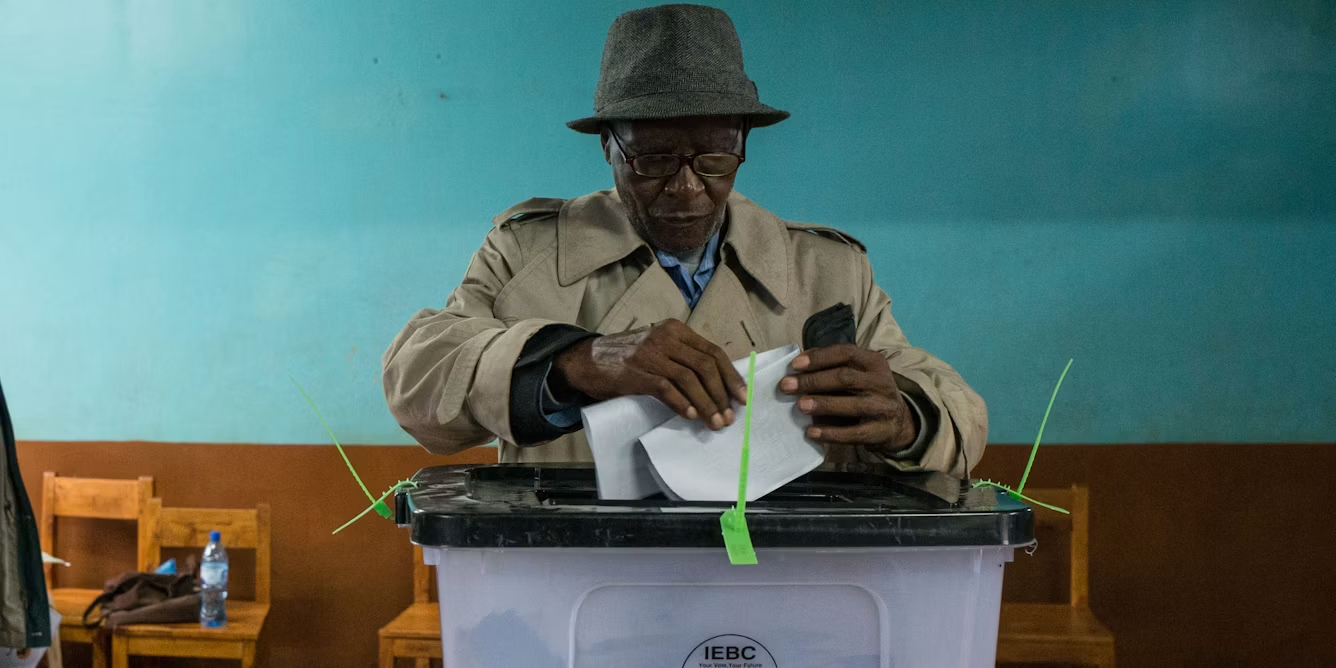
When is Kenya’s next presidential election supposed to happen? While many citizens and political observers have naturally set their sights on August 2027, a landmark ruling delivered on August 7, 2026, by Lady Justice M. Thande at the Malindi High Court has turned standard assumptions on their head.
In High Court Constitutional Petition No. E023 of 2025 (Dr. Owiso Owiso, Khelef Khalifa & Ashioya Biko v. Attorney-General & Independent Electoral and Boundaries Commission), the court addressed a fundamental question regarding Kenya’s democratic timeline: Does the Constitution guarantee a President a full five-year term, or does it mandate elections strictly within the fifth year?
Here is a breakdown of the court’s findings, the mathematical logic behind the ruling, and why the judge chose to suspend the declaration of invalidity.
The Heart of the Petition: “In Every Fifth Year” vs. “After Every Five Years”
The petitioners, Dr. Owiso Owiso, Khelef Khalifa, and Ashioya Biko, challenged the electoral framework used by the Independent Electoral and Boundaries Commission (IEBC). They argued that under Article 136(2)(a) of the Constitution of Kenya, 2010, presidential elections must take place on the second Tuesday in August, in every fifth year, not after five full years have elapsed.
The Mathematical Breakdown of Time
Using the rules for calculating time outlined in Article 259(5)(c) of the Constitution, the petitioners mapped out the years following the August 9, 2022, general election:
- 1st Year: August 9, 2022 – August 8, 2023
- 2nd Year: August 9, 2023 – August 8, 2024
- 3rd Year: August 9, 2024 – August 8, 2025
- 4th Year: August 9, 2025 – August 8, 2026
- 5th Year: Starts on August 9, 2026
Because the fifth year begins on August 9, 2026, the second Tuesday of August in that fifth year lands on August 11, 2026. Consequently, the petitioners argued that scheduling the next election for August 2027 violates the explicit text of the Constitution.
Does the President Have a Guaranteed 5-Year Term?
A central defense raised by the Attorney-General and the IEBC was that holding elections in 2026 would unlawfully truncate the President’s constitutionally protected term. They pointed to synchronized terms for Parliament, County Assemblies, and Governors, arguing that August 2027 is the only practical and harmonized date.
Lady Justice Thande rejected this argument, pointing out a key constitutional distinction:
- Article 142(1): Defines the term of office for the President. It states that the term begins on the day the President is sworn in and ends when the next person elected President is sworn in. Unlike provisions for Members of County Assemblies (Article 177(4)), Article 142 does not explicitly mention a guaranteed five-year duration for the President.
- Historical Intent: The court noted that during the constitution-making process, the public demanded a predictable and fixed election date to prevent incumbents from using election timing as a political tool. The framers chose the wording “in every fifth year” rather than “after every five years”.
“Article 142(1) of the Constitution… is unequivocal that the term of office of the President shall begin on the date the President is sworn in and shall end when the person next elected President pursuant to Article 136(2)(a), is sworn in… Contrary to the assertion by the Respondents, there is no provision in the Constitution that guarantees to the President a 5-year term.” — Lady Justice M. Thande
The Paradox: Why the August 2027 Date Stands for Now
While the High Court agreed with the petitioners’ legal interpretation, it faced a severe practical hurdle.
The IEBC’s Election Operation Plan 2025–2027 had already set August 10, 2027, as the election date, and no operational preparations had been made for an August 2026 election. Ordering an immediate national election on days’ notice would be logistically impossible and risked plunging the nation into constitutional chaos.
Balancing the strict rule of law with judicial restraint, the court issued the following key declarations:
- The Law: Holding a presidential election on any date other than the second Tuesday of August 2026 violates Articles 2, 3, 10, 136, 142, and 259 of the Constitution.
- The Tenure: Neither Article 142 nor any other constitutional provision grants the President a full 5-year term.
- The Stay: The court suspended the declaration of invalidity until after the next general election is held. This grants the IEBC and state authorities the legal breathing room to realign future administrative and electoral frameworks without creating an immediate governance vacuum.
Key Takeaways
- Constitutional Clarity: The High Court confirmed that “in every fifth year” places the constitutional due date for presidential elections on the second Tuesday of August in the 5th year following the last election (August 11, 2026).
- No Fixed 5-Year Tenure: The presidency is governed by election timing cycles under Article 136(2)(a), not a rigid 60-month tenure guarantee.
- Institutional Stability: By suspending the declaration, the Judiciary ensured that practical realities take precedence for the current cycle to prevent administrative disruption.
Access the Full Judgment
To dive deeper into the detailed legal arguments, judicial precedents cited (including Lillian S, Anarita Karimi Njeru, and Muge), and the complete orders issued by the court, you can download the complete court document HERE.










Leave a Reply