


Raila Odinga’s political history is deeply intertwined with the struggle for democracy in Kenya. His journey began under the shadow of his father, Jaramogi Oginga Odinga, Kenya’s first Vice-President and a prominent opposition figure. Because of his activism and his father’s stance against the ruling Kenya African National Union (KANU) government, Raila was detained for several years without trial during the regimes of Jomo Kenyatta and Daniel Arap Moi. Official government records, such as the “Akiwumi Commission Report,” documented the political persecutions of that era, which heavily featured Odinga.
A pivotal moment in his early political career was his involvement in the 1982 attempted coup d’état. The government of the day accused him of involvement, a charge he has consistently denied, though it led to his detention. Following pressure for multi-party democracy in the early 1990s, Odinga was a key figure in the formation of the Forum for the Restoration of Democracy (FORD), a major opposition party. He later founded his own party, the Orange Democratic Movement (ODM), which became the vehicle for his presidential bids.
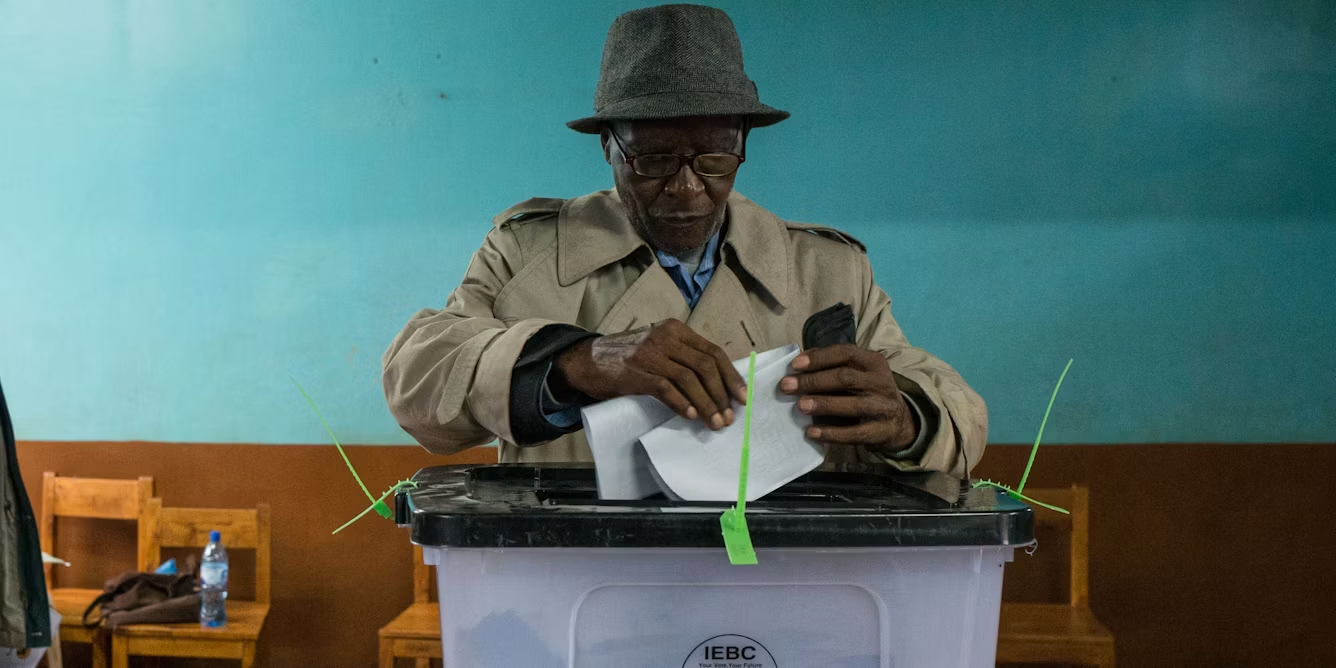
His most significant electoral contest was in 2007, when he ran against incumbent Mwai Kibaki. The official results declared by the Electoral Commission of Kenya (ECK), which proclaimed Kibaki the winner, were fiercely disputed. This triggered widespread ethnic and political violence, leading to the death of over 1,000 Kenyans. A primary source, the “Report of the Independent Review Commission on the General Elections of 2007” (the “Kriegler Report”), found that the election’s tallying process was so flawed that “it was impossible to determine with certainty the final result.” This political crisis was resolved by a power-sharing agreement, the “National Accord and Reconciliation Act, 2008,” which created the position of Prime Minister for Odinga.
He continued to be a central figure in Kenyan politics, running for president in 2013, 2017, and 2022. The 2017 election was particularly notable; after the Supreme Court of Kenya, in a historic ruling (Petition No. 1 of 2017), nullified the initial presidential election due to “illegalities and irregularities,” it was the first time a court in Africa had overturned a presidential election. Odinga’s legacy is that of a persistent champion for democratic reforms, often nicknamed “Agwambo” (The Mysterious One) for his unpredictable political maneuvers.



Leave a Reply