



The Law Society of Kenya has invited applications for conferment of the rank of Senior Counsel for 2026. Applications, with supporting evidence, go to the Secretary/CEO online and in hard copy at the LSK Secretariat in Lavington by 5:00 p.m. on Friday, 16 October 2026. It is worth noting that the Secretariat moved to South C many months ago and an inadvertent error must have occurred in the description.
A holder of the rank may use the designation “SC” and enjoys precedence in having their matters mentioned in court, the right when robed to wear the gown and court-sleeved waistcoat of a Court of Appeal judge, the exclusive right to sit within the Bar or otherwise on the front bench, and such other privileges as the Council may grant. Less visibly, the rank takes the holder outside the jurisdiction of the Advocates Disciplinary Tribunal.
To qualify one must possess at least fifteen years’ standing as an Advocate and be a person of irreproachable professional conduct who has rendered exemplary service to the legal and public service in Kenya. Rule 7 of the Advocates (Senior Counsel Conferment and Privileges) Rules, 2011 adds 9 cumulative tests: active practice and training of other members of the profession; a valid practicing certificate; no finding of professional misconduct; sound knowledge of the law and competence; having argued a substantive matter before a superior, regional or international court; integrity and good character; service to the Society, a bar association or the community; and contribution to the profession through scholarly writing and presentations. Every box must be ticked.
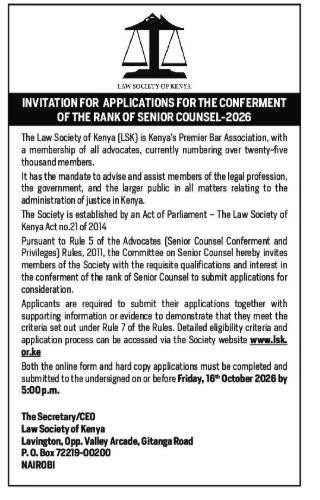
Rule 5 obliges the Committee on Senior Counsel to invite applications “in each year,” with a default 31 March deadline, six months to decide and thirty days to forward its list to the Chief Justice; section 17(3) then gives the President sixty days to issue the letters.
That is an annual cycle by design. In practice cohorts have come years apart, with a three-year gap between 2022 and 2025, the Committee’s power to set “such date as it shall determine” having become a power to skip years. This call, barely a year after the last, is the first sign in a long time that the Rules will be followed as written.
The last conferment was in December 2025, when 54 advocates took silk, the largest cohort ever, lifting the roll from 66 to 120. It included Noordin Haji, Moses Wetang’ula, Elisha Ongoya, Ahmed Issack Hassan and Katwa Kigen, the President’s former ICC defence counsel. It was also the most contested. Former LSK President Allen Gichuhi, SC, went to the High Court to quash the list, singling out Nelson Havi, who carried a 2025 Disciplinary Tribunal finding of misconduct with only sentencing suspended, and pointing to Rule 7’s bar on anyone with such a finding. Justice Roselyn Aburili dismissed the petition for failure to exhaust the statutory appeal mechanism, so the merits were never decided. The question it raised is very much alive for this round.
Neither the Act nor the Rules limit how many advocates the Committee may recommend; Rule 12 asks only for “a list of the names of the persons it recommends.” That is right in principle, since merit does not come in annual quotas and a cap would force the Committee to turn away the deserving in a strong year and fill numbers in a weak one. But an uncapped rank conferred every year, after a round that made 54 in one sitting, invites the obvious question: how long before silk becomes commonplace and the prestige drains out of it? Other jurisdictions guard against that through the rigour of selection rather than through numbers, and rigour is precisely what the 2025 challenge put in doubt.
The Rules recognise only one route to the rank: self-application under Rule 6. Consider Dr. John Khaminwa, admitted as Advocate No. 565 in 1970, Kenya’s most enduring public-interest litigator, Jurist of the Year at 87, hailed as “the people’s Senior Counsel,” and still in practice after turning 90 this year. He does not hold the rank, and it is not publicly known whether he has ever applied. Many advocates of his generation regard putting oneself forward for an honour as unseemly, and the roll therefore flatters the ambitious and passes over the modest. We would recommend that either the Committee, the Council or a group of peers should be able to nominate an advocate, with their consent, alongside the self-application route. Nothing in section 17 prevents it; it would take only an amendment to Rule 6. If the Society intends to make the rank an annual event, it should at least open the door to those who will never knock on it themselves.










Leave a Reply