


It was a heavy week in Kenya’s courts. Thursday alone produced three headline rulings — a murder conviction, a high-profile acquittal, and a constitutional check on the Executive — while the country’s advocates escalated their standoff with the Judiciary into a nationwide boycott, and the harrowing trial over Albert Ojwang’s death in police custody laid bare a scheme to erase the evidence. Here is the week in review.
The headline judgments
Obado convicted of Sharon Otieno’s murder
Nearly eight years after the killing that gripped the nation, former Migori Governor Zachary Okoth Obado was found guilty of the murder of Rongo University student Sharon Otieno. Delivering the verdict at the Milimani Law Courts on Thursday, 23 July, Justice Cecilia Githua held that the prosecution had proved its case “beyond reasonable doubt” against Obado and his two co-accused, his personal assistant Michael Oyamo and clerk Caspal Obiero.
The court found that Obado had a strong motive to silence Sharon — a fear of political embarrassment and reputational damage as their affair and her pregnancy threatened to become public. Justice Githua accepted that Oyamo orchestrated the fatal meeting at Rongo’s Graca Hotel and fraudulently acquired a SIM card used to facilitate the crime, and held that an unbroken chain of circumstantial evidence linked all three men to the offence.
Sharon, 26 and roughly seven months pregnant, was abducted alongside journalist Barack Oduor on 3 September 2018 and later found dead near Kodera Forest with multiple stab wounds. The trial ran for close to eight years and heard 42 prosecution witnesses. The three convicts had their bond cancelled and were remanded for 21 days pending sentencing. Women’s rights groups and the Office of the Director of Public Prosecutions welcomed the conviction as a landmark moment in the fight against gender-based violence and impunity.
Mandago acquitted in the Sh1.1 billion Finland scholarship case
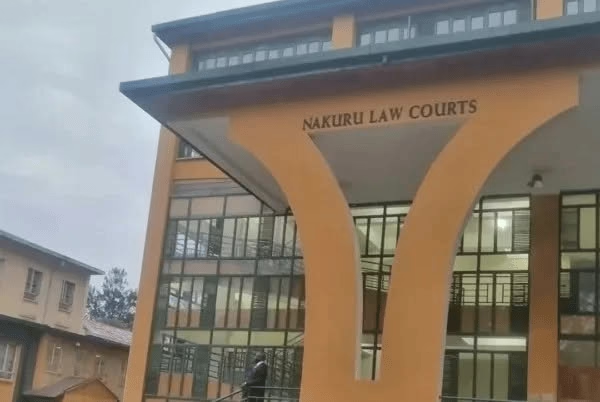
On the same day, in Nakuru, the scales tipped the other way. Senior Principal Magistrate Peter Ndege acquitted Uasin Gishu Senator Jackson Mandago and two co-accused of fraud charges tied to the county’s ill-fated overseas education programme, which sent students to Finland and Canada.
Ndege ruled that “the prosecution has failed to establish a prima facie case in any of the charges herein,” finding the evidence fell short of the legal threshold required to place the accused on their defence. He was careful to note that an acquittal on those grounds is not a declaration of factual innocence but a finding that the State had not proven its case to the required standard.
The case had centred on some Sh1.1 billion raised from parents for scholarships that, for many students, never materialised as promised. In the aftermath, Mandago called on beneficiaries to refund money received and urged the county government to pursue restitution for the affected parents — a striking coda to a scandal that left many families out of pocket.
High Court nullifies Ruto’s public debt audit taskforce
The High Court at Malindi struck down President William Ruto’s Presidential Taskforce on the Forensic Audit of Public Debt, ruling it unconstitutional. In a judgment delivered on Thursday, 23 July, Justice Lawrence Mugambi held that the taskforce — created by Executive Order No. 4 of 2024 — unlawfully duplicated functions already vested in an independent constitutional office.
Invoking the principle of legality, Justice Mugambi reasoned that every public office, “including the Presidency,” may exercise only those powers expressly granted by the Constitution, and found that the President had exceeded his constitutional authority. Petitioners had also argued the taskforce was formed without public participation and that its members’ appointments failed constitutional tests of merit, transparency and inclusivity. The Government had defended it as a legitimate advisory body. The court quashed the Executive Order, branding it an “unconstitutional, invalid and unlawful duplication” of an independent office’s mandate.
Infrastructure Fund survives — but under judicial watch
Also on Thursday, 23 July, Justice Patriciah Nyaundi declined to suspend the National Infrastructure Fund Act, 2026, in a constitutional challenge brought by the Katiba Institute, but placed its rollout under strict judicial oversight. The National Treasury must maintain “full transparency and accountability over the fund’s operations” and account for all expenditure while the petition proceeds to a full hearing.
The judge described the order as “a less intrusive” alternative to freezing the Act altogether, while acknowledging that “the constitutional challenges raised by the petitioner are weighty, arguable and deserve a full hearing on their merits.” The Act — assented to in March 2026 to mobilise up to Sh5 trillion in private capital for infrastructure — now proceeds with a judicial leash attached.
In the trial courts: the Albert Ojwang murder trial
The most closely watched trial of the week continued at the Kibera High Court, where six people — including former Central Police Station OCS Samson Kiprotich Talaam, constables James Mukhwana and Peter Kimani, John Ngige Gitau, Gin Ammitou Abwao and Brian Mwaniki Njue — are charged with the murder of teacher and blogger Albert Ojwang, who died in police custody in the early hours of 8 June 2025.
The week’s most damning testimony came on Monday, 20 July, from a protected witness code-named “DAN,” who told Justice Diana Kavedza he was summoned to Central Police Station on 8 June 2025 and instructed to erase surveillance footage from 6–7 June. Because the system could not selectively delete specific dates, he said, he formatted the Digital Video Recorder entirely — receiving Sh3,000 in cash for the deletion and a further Sh20,000 to buy hard disks that were ultimately never used. The prosecution has framed the killing as planned, arguing the cover-up points to premeditation.
IPOA forensics head Joshua Mutua then walked the court through reconstructed CCTV from the station and Mbagathi Hospital, footage that showed officers removing Ojwang’s body from a police vehicle at around 2:11 am before returning it moments later — with the judge herself noting the officers “appeared to move without urgency” despite evidence he was already unresponsive. The trial was adjourned to 14 December 2026 for Mutua’s cross-examination. All six accused have denied the charge.
The Bar in revolt: LSK’s nationwide court boycott
The Law Society of Kenya escalated its long-running standoff with the Judiciary into a nationwide court boycott, with advocates staying out of hearings on Wednesday, 22 July. First announced on 18 July, the action protests what the Society calls persistent failures in judicial administration — delayed hearings and slow rulings, registry inefficiencies, poor working conditions for advocates, and, most pointedly, weak accountability mechanisms for errant judicial officers. The LSK went as far as naming a list of judges and a magistrate it wants held to account.
Advocates were directed to keep away from hearings and applications, while case filing and mentions to secure fresh dates or extend interim orders were allowed to continue so litigants would not be prejudiced. The pressure spilled into the counties: on 23 July, the Society’s Rift Valley branch boycotted Nakuru Court No. 4, pressing for a magistrate’s transfer. The LSK says the boycott will continue until its accountability concerns are addressed; the Judiciary had earlier publicly told off the Society over the planned action, setting up a tense confrontation between Bar and Bench.
Cases filed
The Kenya Petroleum Oil Workers Union (KPOWU), represented by senior counsel Nelson Havi, moved the High Court to remove Kenya Pipeline Company board chair Faith Bett Boinett, alongside the acting Managing Director and the National Treasury Cabinet Secretary, among others. The petition alleges Boinett’s appointment bypassed the competitive recruitment required under the Government Owned Enterprises Act, 2025, flags an alleged conflict of interest over her ties to a company that transacts with KPC, and challenges decisions taken by what it calls a caretaker board after April 2026. Justice David Mburu certified the matter urgent, with a mention set for 29 July 2026.
Legislative and gazette watch
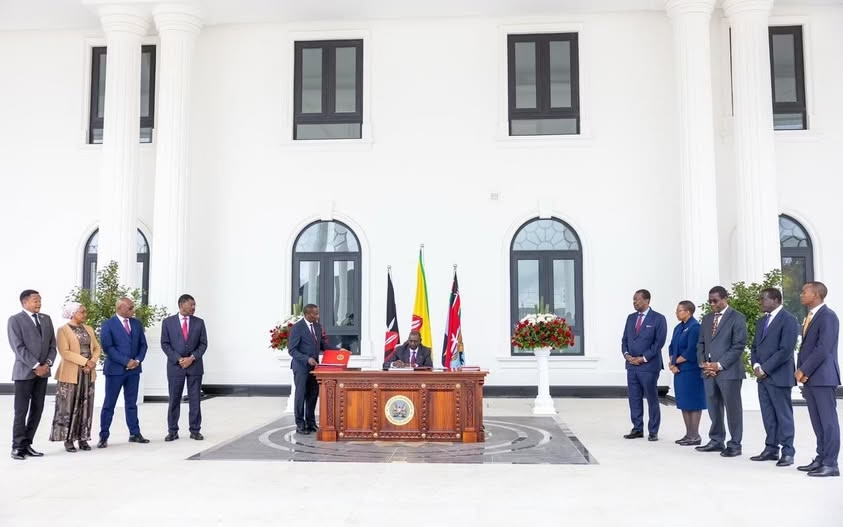
No major statute was assented to during the 20–24 July window, but several threads are worth tracking. The National Infrastructure Fund Act, 2026 (assented in March) dominated the week through its constitutional challenge, noted above. Earlier in July, the President signed a raft of laws including the new Central Bank of Kenya framework and Sovereign Wealth Fund legislation, and the Finance Bill, 2026 continues its passage through Parliament — the perennial flashpoint to watch as the next revenue cycle approaches.
Also on the docket
Two further matters merit a watching brief. Litigation over the country’s multi-trillion-shilling “odious debt” suit continued to wind through the courts, with the State seeking to suspend proceedings. And earlier in the month the constitutional questions around the Executive kept stacking up: a three-judge bench declared the Cabinet unconstitutional over the two-thirds gender rule (ruling of 1 July, now under appeal by the National Assembly), while conservatory orders of 9 July barred National Assembly Speaker Moses Wetang’ula and Senate Speaker Amason Kingi from deploying their offices in partisan campaigns.



Leave a Reply