


Ruling delivered on 23 July 2025
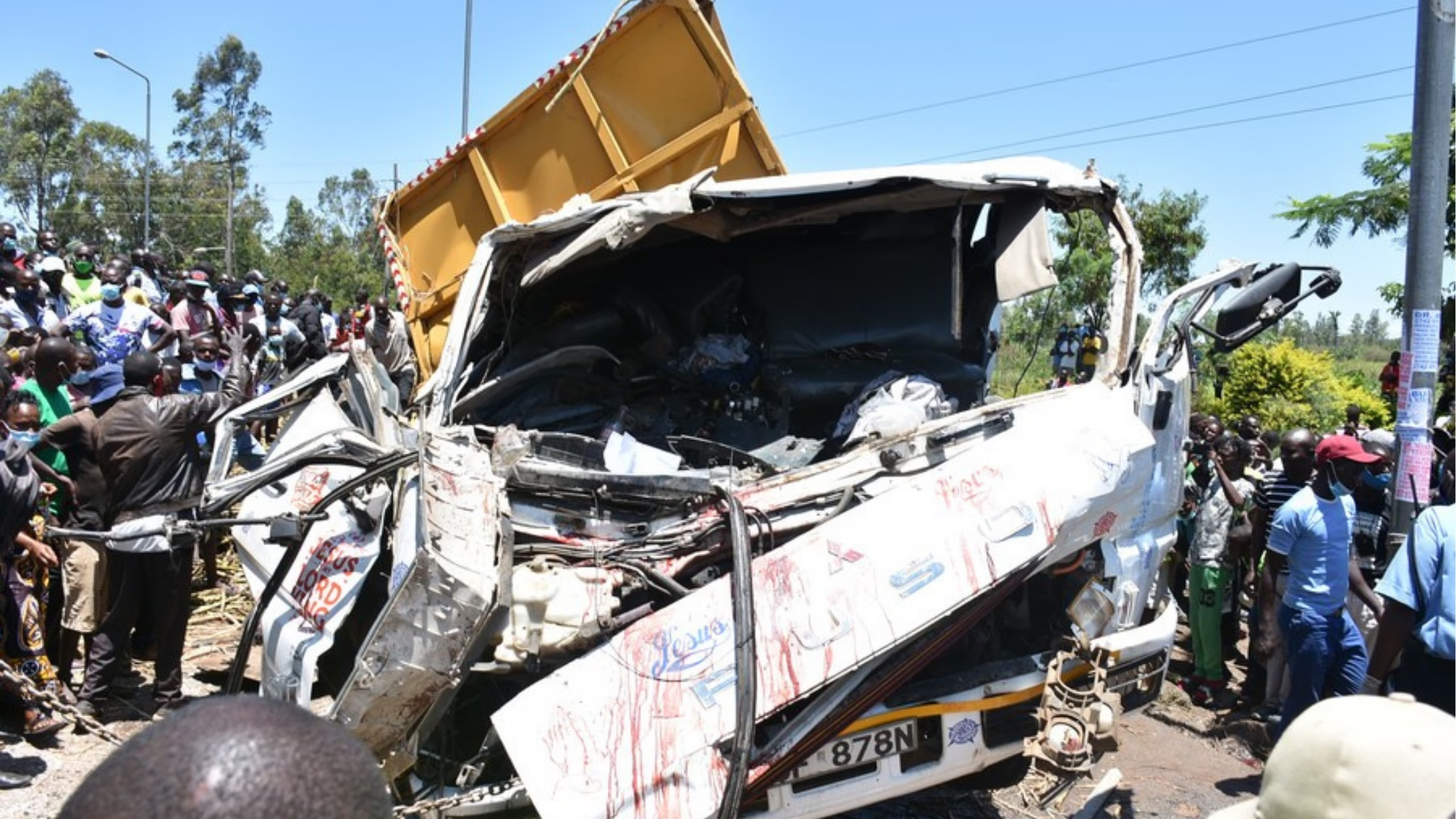
For years, a single document has quietly dominated road traffic accident litigation in Kenya: the police abstract. In countless cases, it has been treated as shorthand for liability, a near-automatic confirmation of who caused an accident. On 23 July 2025, the High Court of Kenya firmly dismantled that assumption.
In Ngure v Maina (Civil Appeal E166 of 2024) [2025] KEHC 11696 (KLR), the High Court at Nairobi delivered a judgment that does more than resolve a dispute between two motorists. It restates, clearly and unequivocally, a foundational principle of civil justice: liability is proved by evidence, not paperwork.
The Case at a Glance
- Case: George Kinuthia Ngure v Benson Mwangi Maina
- Court: High Court of Kenya at Nairobi (Milimani Law Courts)
- Judge: D.K.N. Magare, J
- Date of Judgment: 23 July 2025
- Appeal From: CMCC No. E5990 of 2022 (Judgment delivered on 17 November 2023)
The appeal arose from a road traffic accident claim in which the trial court had found the appellant liable. Dissatisfied with that finding, the appellant challenged the decision, arguing that liability had not been properly proved.
The Central Question Before the High Court
At the heart of the appeal was a deceptively simple but legally critical question:
Does a police abstract, on its own, prove who caused a road traffic accident?
The High Court’s answer was unambiguous.
What the Court Decided
1. A Police Abstract Does Not Prove Negligence
The Court firmly held that a police abstract does not establish how an accident occurred, nor does it determine who was negligent. Its purpose is limited.
A police abstract only confirms that:
- An accident was reported
- Certain vehicles and persons were involved
- The report exists in police records
It does not explain causation, it does not allocate blame, and it does not meet the evidentiary threshold required to prove negligence.
This clarification directly challenges a long-standing but incorrect practice where abstracts are treated as near-conclusive proof of liability.
2. Police Officers Who Did Not Witness the Accident Cannot Prove Causation
The Court went further and addressed the evidentiary value of police testimony.
Where a police officer did not witness the accident:
- Their testimony on how the accident occurred is limited to what was reported to them
- Such testimony, when relied on to prove fault, is hearsay
- It cannot, on its own, support a finding of negligence
The Court emphasized that liability cannot be determined through second-hand accounts recorded after the fact.
3. Liability Is Evidentiary, Not Administrative
Perhaps the most important contribution of this judgment is its clear restatement of principle:
Liability in civil cases is evidentiary, not administrative.
In other words:
- Liability is not created by police paperwork
- It is not established by reports or forms
- It is proved through admissible evidence presented in court
That evidence includes:
- Direct testimony
- Eyewitness accounts
- Consistency of narratives
- Proof of negligent conduct
This approach aligns road traffic accident claims with the broader requirements of the Evidence Act and civil procedure.
Why the Respondent Ultimately Succeeded
Despite rejecting the police abstract as proof of liability, the High Court upheld the finding against the appellant. This outcome is critical to understanding the judgment.
Credible, Consistent Testimony
The respondent gave a clear account that he was hit from behind while lawfully on the road. His testimony was:
- Logical
- Consistent
- Corroborated by a pillion passenger, an independent eyewitness
In civil law, once a party presents a coherent and supported version of events, the burden shifts.
Silence from the Appellant
The appellant’s case collapsed not because of the police abstract, but because of silence.
- The appellant did not testify
- The driver did not testify
- No alternative account of the accident was offered
- No rebuttal evidence was placed before the court
The High Court reaffirmed a basic rule of civil litigation: unchallenged evidence is deemed admitted.
Once the respondent’s account stood unrebutted, the Court had no difficulty affirming liability.
Key Lessons from the Decision
This judgment delivers several important takeaways for litigants, lawyers, insurers, and trial courts:
For Claimants
A police abstract is not enough. Claimants must:
- Testify
- Explain how negligence occurred
- Call eyewitnesses where available
For Defendants
Silence is costly. If a defendant does not testify or rebut evidence, the court will rely on the opposing version of events.
For Courts
Liability analysis must focus on evidence, not administrative documents prepared after the accident.
Why This Decision Matters
Ngure v Maina does not introduce new law. Instead, it performs something just as important: it clarifies and enforces existing principles that had been diluted by practice.
By doing so, the High Court:
- Restores evidentiary discipline in road traffic claims
- Prevents shortcuts that undermine fairness
- Reinforces the central role of testimony and proof
In an area of law crowded with assumptions, this judgment brings clarity.
Conclusion
The message from the High Court is direct and unavoidable:
A police abstract alone will not win you a road traffic accident case.
Evidence will. And where one party speaks clearly and the other remains silent, the court will not hesitate to draw the necessary conclusions.








Leave a Reply