


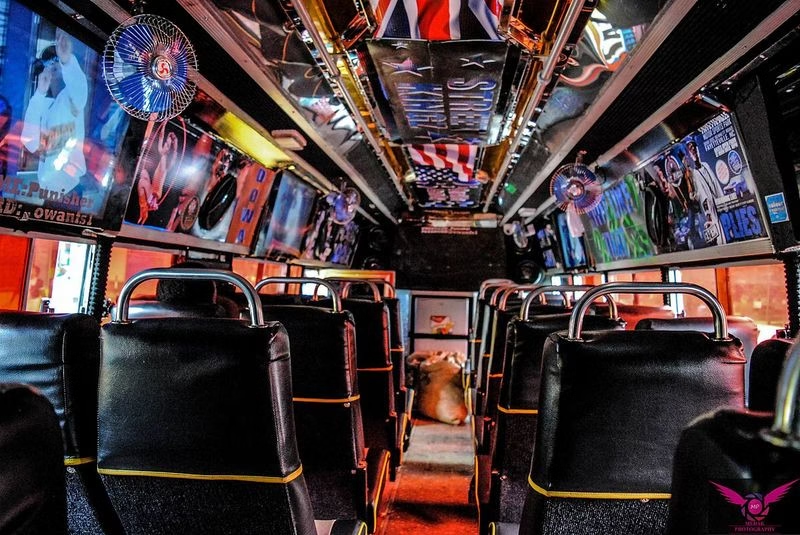
Introduction: A Daily Commute That Became a Constitutional Question
For millions of Kenyans, the matatu is not a luxury, it is life. It takes children to school, workers to their jobs, patients to hospitals, and families back home after long days. Yet for many commuters, what should be a simple journey has increasingly become an assault on the senses.
Blaring speakers. Drum-heavy bass. Music played without warning, without consent, and without regard to who is on board.
In Constitutional Petition No. E861 of 2025, Advocate Samwel Barongo Nyamari has taken this everyday experience to the High Court, asking a fundamental question:
Can loud, unsolicited music in public service vehicles amount to a violation of constitutional rights?
Filed in the Constitutional and Human Rights Division of the High Court in Nairobi, the petition brings together issues of human dignity, consumer protection, environmental rights, health, disability inclusion, and public accountability, all through the lens of an ordinary matatu ride.
This case is not just about music. It is about choice, dignity, and the right to commute in peace.
The Parties: Who Is Suing Whom, and Why It Matters
- The Petitioner:
Samwel Barongo Nyamari, a Kenyan citizen, public-spirited litigant, and Advocate of the High Court of Kenya. - The Respondents:
- Matatu Owners Association, representing PSV owners and operators
- National Transport and Safety Authority (NTSA), regulator of public transport safety and standards
- National Environment Management Authority (NEMA), mandated to protect the right to a clean and healthy environment
- The Attorney General, sued on behalf of the Government of Kenya
The petition squarely places responsibility not just on matatu operators, but also on state agencies accused of failing to regulate and enforce existing standards.
What Triggered the Petition: Six Years of Unsolicited Noise
According to the petition, the petitioner has used matatus in Nairobi almost daily for over six years. During this period, he, and countless other commuters, has been subjected to:
- Loud, unsolicited, repetitive music
- Drum-heavy sound systems installed in PSVs
- Noise played indiscriminately to all passengers
Crucially, the petition highlights that commuters are never warned before boarding that loud music will be played. Once inside, they are trapped, unable to opt out without abandoning their journey altogether.
The petition describes this as a “silent pandemic” affecting:
- Babies and young children
- The elderly
- People with autism and sensory sensitivities
- The sick and fatigued
- Passengers needing to make phone calls or simply rest
The Constitutional Backbone: Which Rights Are Allegedly Violated?
The petition is anchored on several key provisions of the Constitution of Kenya, 2010:
1. Article 42: Right to a Clean and Healthy Environment
Noise pollution, the petitioner argues, is an environmental issue. Loud music inside enclosed PSVs amounts to environmental degradation of personal space, denying commuters a clean and healthy commuting environment.
2. Article 2: Freedom and Security of the Person
The Constitution protects individuals from:
- Psychological torture
- Cruel, inhuman, or degrading treatment
The petition frames incessant loud music as psychological violence, especially when it is unavoidable and prolonged.
3. Article 46: Consumer Rights
Consumers are entitled to:
- Services of reasonable quality
- Information necessary to benefit from services
- Protection of their health and safety
By failing to warn passengers of loud music, matatu operators are accused of ambushing consumers, denying them informed choice.
4. Article 43: Right to the Highest Attainable Standard of Health
Exposure to loud noise poses risks to:
- Developing eardrums of children
- Age-weakened hearing of the elderly
- Sensory-sensitive individuals, including autistic commuters
The petition positions noise as a public health issue, not mere inconvenience.
The Reasoning Behind the Petition: Why This Case Matters
At its core, the petition is driven by a simple but powerful argument:
Public transport should serve the public, not torture it.
The petitioner argues that:
- Matatus are not entertainment venues; they are essential public utilities
- Passengers do not consent to loud music simply by boarding
- Vulnerable groups are disproportionately harmed
- Regulators have failed to enforce reasonable standards
This is a classic public interest litigation, brought not just for the petitioner, but “on behalf of the young, the autistic, the sickly, the old, and the general public.”
What the Petitioner Is Asking the Court to Do
Among the key reliefs sought are:
- A declaration that loud music in PSVs is unconstitutional
- A finding that it violates Articles 29, 42, 43, and 46
- An order prohibiting PSVs from playing loud music
- A mandatory order directing NTSA, NEMA, and the Attorney General to enforce compliance
If granted, these orders could fundamentally reshape commuter culture in Kenya.
The Bigger Picture: Disability Rights, Inclusion, and Silent Commutes.
This case speaks directly to disability inclusion. For autistic individuals and those with sensory processing disorders, loud noise is not just unpleasant, it can be debilitating.
The Constitution guarantees equality, dignity, and non-discrimination. A transport system that ignores sensory needs effectively locks out a segment of the population from public life.
Equally important are:
- Elderly commuters seeking calm
- Parents travelling with infants
- Workers exhausted after long shifts
Silence, or at least moderation, is not a luxury. It is accessibility.
What Matatus Should Do Going Forward
Regardless of the court’s final determination, this petition offers a clear roadmap for reform:
1. Introduce Silent or Low-Noise Options
Not every matatu must be silent, but commuters should have real choices.
2. Mandatory Disclosure Before Boarding
Passengers must be informed upfront if music will be played, and at what volume.
3. Volume Regulation and Enforcement
NTSA and NEMA should set clear decibel limits for PSVs.
4. Disability-Sensitive Transport Policies
PSVs should adopt inclusive standards that recognise autism and sensory disabilities.
5. Training Conductors and Drivers
Human dignity begins with awareness. Operators must understand the impact of noise on health and rights.
Why This Case Is One to Watch
Constitutional Petition E861 of 2025 transforms an everyday annoyance into a constitutional moment. It asks Kenya to rethink how public spaces function, whose comfort matters, and whether dignity can exist without consent.
And for the law, a reminder that rights live not only in courtrooms, but in matatus, traffic jams, and daily journeys home. Read more HERE
For commuters, it is a voice.
For regulators, a reckoning.
For matatu operators, a call to modernize.
Legal Express Kenya will continue to follow this case closely and provide updates, analysis, and commentary on its implications for public transport, disability rights, consumer protection, and constitutional law.





Leave a Reply