


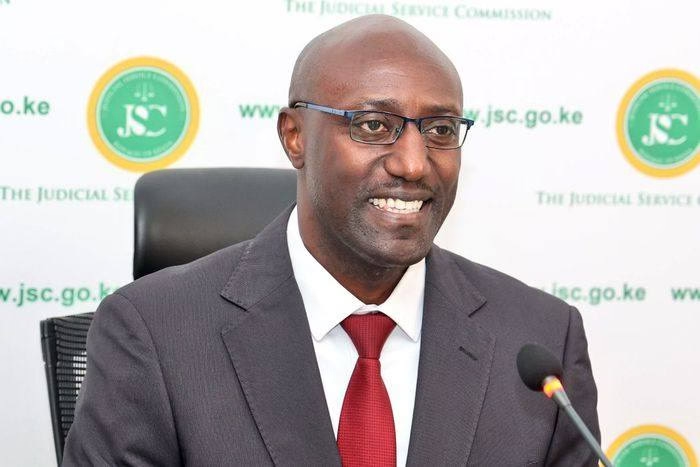
After a rigorous two-month marathon of publicly broadcast interviews, the Judicial Service Commission (JSC) on Friday, 10th April 2026 nominated 24 individuals to serve as Judges of the High Court and 13 as Judges of the Environment and Land Court (ELC).
The original advertised vacancies stood at 20 for the High Court and 10 for the ELC. These were expanded mid-process to 24 and 13 respectively, after the conclusion of the Court of Appeal recruitment resulted in promotions from both courts, thereby creating additional vacancies. Rather than initiate a fresh recruitment process, the JSC invoked Rule 20(2) of the First Schedule to the Judicial Service Act, a course of action affirmed by the High Court in Okoiti Omtatah v JSC, which held that the Commission may fill vacancies arising during an ongoing recruitment exercise without restarting the process.
The Interviews: A Study in Contrasts
The live broadcast of the interviews generated significant public interest and mixed reactions. Some candidates — among them Bellinda Akello and Dr. Nabil Orina — performed exceptionally well, demonstrating command, clarity, and intellectual depth. Others, however, left observers bewildered as to how individuals holding senior public offices or advanced academic credentials could display such a pronounced gap between their paper qualifications and their actual grasp of the law.
One senior candidate from the Office of the Director of Public Prosecutions attracted particular attention for the wrong reasons. Despite occupying an office that directly determines the course of criminal justice for countless Kenyans, she was unable to distinguish between a Verifying Affidavit and a Supporting Affidavit — a foundational distinction for any practicing lawyer. Her interview, lasting barely 25 minutes, was the shortest of the entire exercise, a fact that spoke volumes about how quickly the panel had formed its conclusions.
The live broadcast also raised legitimate questions about the propriety of airing every moment of what are, in part, deeply personal exchanges. It was uncomfortable to watch Hon. Robinson Ondieki — a serving Chief Magistrate — being pressed repeatedly by Commissioner Hon. Fatuma Sichale about his secondary school grades and whether he had gained admission to the Kenya School of Law through legitimate means. That a senior Commissioner would subject a sitting judicial officer to such a public inquisition left many observers questioning both the necessity and the fairness of the line of questioning.
Scale and Competitiveness
The recruitment exercise was extraordinarily competitive. The JSC received 377 applications for the High Court, from which 100 candidates were shortlisted for interview, and 243 applications for the ELC, from which 50 were shortlisted. Of those who reached the interview stage, only 37 ultimately made the final cut — translating to a success rate of roughly 1 in 10 for the High Court and 1 in 19 for the ELC.
Overall, the caliber of High Court candidates appeared stronger than those who appeared for the ELC — with the conspicuous exception of Bellinda Akello, who stood head and shoulders above many of her High Court counterparts.
A First in Kenya’s Judicial History
The nomination of Joseph Kipkoech Biomdo is, quietly, one of the most remarkable stories to emerge from this entire exercise. Biomdo is a serving Kenya Defense Forces officer holding the rank of Colonel — and if appointed, he would almost certainly become the first military officer in Kenya’s independent history to ascend directly from the KDF to the High Court bench.
As a legal officer within the KDF, Biomdo would have operated in a world far removed from the conventional practice of most of his fellow nominees: advising commanders on rules of engagement, prosecuting and defending in courts-martial, and navigating the unique intersection of military discipline and constitutional rights. That experience, combined with the discipline, decisiveness, and adherence to hierarchy that military culture instils, gives him a perspective that no civilian candidate in this cohort can replicate. His is a nomination that deserves far greater attention than it has received.
The Supreme Court Registrar Makes the Cut
The nomination of Hon. Letizia Muthoni Wachira Rwiga was, in many respects, unsurprising — yet no less deserved for that. As the Supreme Court Registrar, she occupies one of the most senior administrative positions in Kenya’s judiciary, with over two decades of experience climbing through the ranks from District Magistrate to the apex court’s administrative helm. It would have been extraordinary had she not been nominated.
Her interview produced one memorable moment of quiet assertiveness: when a question implicitly assumed her Kikuyu ethnicity on account of her surname, she calmly corrected the record, explaining that she is Meru – “Wachira” is her husband’s name, not her father’s — a distinction that carries significance in a process where ethnicity and regional balance are material considerations.
A State Counsel Crosses Over
The nomination of Emmanuel Omondi Bitta represents a significant transition from the Attorney General’s office to the bench. Few candidates in this cohort generated as immediate a consensus among the interviewing panel. Supreme Court Judge Njoki Ndung’u observed during his interview that she could not identify a single consequential matter before the Supreme Court in which Bitta had not appeared as state counsel — a testament to the breadth and depth of his career at the highest levels of public interest litigation.
Indeed, Justice Ndung’u went further, suggesting that Bitta was perhaps overqualified for the High Court and ought to have set his sights on the Court of Appeal or even the Supreme Court. His nomination, by contrast, was never seriously in doubt.
The Advocates Who Captured Public Attention
For the ELC, Bellinda Akoth Akello was without question the standout performer of the entire exercise — High Court candidates included. Her oratory was articulate, assured, and precise, and she backed it with a formidable academic arsenal: at least four university degrees, alongside qualifications as a Chartered Arbitrator, Certified Mediator, and Certified Public Secretary. She was the kind of candidate who makes the interview panel sit up.
Adding a poignant dimension to her story was the fact that her sister, Neddie Eve Adhiambo Akello, had applied for a position as a High Court Judge and did not make the final cut. Had both succeeded, it would have been a historic first — two siblings appointed to the superior courts on the same day. That record remains unwritten.
Dr. Nabil Mokaya Orina was among the most closely watched High Court candidates, and he did not disappoint. The current Chairperson of the Land Acquisition Tribunal, he answered complex legal questions with a disarming simplicity and precision that belied the depth of his knowledge. His command ranged fluently across land law, criminal law, and constitutional law, prompting observers to wonder which division of the High Court would benefit most from his appointment.
The Nominations Favored Magistrates
Of the 37 nominees, 21 are serving or former magistrates — with the High Court accounting for 13 of them. This continued dominance of the magistracy in judicial recruitment reflects the JSC’s enduring preference for candidates with direct judicial experience, even at the cost of diversity of professional background.
A Historic Judicial Expansion
Once the President formally appoints the nominees, the High Court bench will grow from 91 to 115 judges, while the ELC will expand from 48 to 61. Taken together, this is one of the single largest expansions of Kenya’s superior court judiciary since independence — a development that, if accompanied by commensurate investment in infrastructure and court administration, has the potential to make a material dent in the country’s chronic case backlog.
Notable Candidates who Missed Out
Priscilla Nyokabi Kanyua was perhaps the most high-profile casualty of the process. A former Nyeri Woman Representative (2013–2017), former Commissioner of the National Gender and Equality Commission, and former Executive Director of Kituo Cha Sheria, Nyokabi carried one of the most layered public service CVs in the room. Her nomination would have made her only the second woman to cross from Parliament to the judiciary — the first being Njoki Ndung’u, now a Supreme Court Judge and JSC Commissioner.
It is worth pausing on the broader history of the Parliament-to-Judiciary pathway. Other individuals who have made this transition include the late Justice Jackson Kasanga Mulwa, who served as MP for Makueni Constituency from 1969 to 1983 before joining the bench, and Justice Chunilal Madan, who was an elected member of the Legislative Council representing Nairobi from 1948 to 1961 before being appointed a puisne judge. Madan went on to join the Court of Appeal and eventually served as one of Kenya’s most celebrated Chief Justices from 1985 to 1986.
The reverse trajectory is also on record. The late Justice Kitili Mwendwa served as Kenya’s Chief Justice from 1968 to 1971, before re-entering politics as MP for Kitui Central from 1984 until his death in 1985 — a rare instance of a man who descended from the apex of the judiciary to the legislature.
Conrad Mugoya Bosire was another closely watched candidate who did not make the cut. As Chief of Staff to Chief Justice Emeritus David Maraga, Bosire brought unparalleled institutional knowledge of the judiciary’s inner workings. Yet institutional familiarity, it seems, was insufficient to carry the day. Others who fell short include Anne Ireri, former Executive Director of FIDA Kenya, and Annah Konuche, Director of the Council for Legal Education.
Among the serving magistrates shortlisted and publicly interviewed but not nominated were Hon. Pamella Achieng Khamoni, Hon. Douglas Nyambane Ogoti, Hon. Esther Kalunde Kimilu, Hon. Lucas Onyango Onyina, Hon. Benard Maina Ochoi, Hon. Angela Njeri Thuku, Hon. Abdulqadir Lorot, Hon. Felix Mutinda Kombo, and Hon. Barbara Achieng Ojoo, among others.
A number of candidates were appearing before the JSC for the second or third time, having been interviewed during the 2024 High Court exercise (which was subsequently cancelled following the Gen Z-driven budget crisis) and in some cases in earlier cycles as well. These persistent repeat applicants include Crispin Owiye (formerly IEBC Head of Legal Services), Dr. Andrew Barney Wanjala Khakula, Hon. Barbara Achieng Ojoo, Hon. Beatrice Muthoni Kimemia, Elizabeth Achieng Agutu, and Hon. Eunice Kagure Nyutu. Their persistence speaks to genuine commitment; the repeated non-nominations raise harder questions about what the JSC is looking for that these candidates are consistently unable to provide.
Overall Assessment
On balance, the list of nominees appears well-merited. The JSC’s process was, by any measure, rigorous and transparent — 377 applications, 100 interviews, and only 24 places for the High Court is a brutal filter by any standard.
That said, it is difficult to avoid the conclusion that some strong candidates were disadvantaged not by any deficit of ability but by the imperatives of ethnic, gender, and regional balancing. Candidates such as Hon. Anne Wanjiru Mwangi, Margaret Kimani, Hon. Eunice Kagure Nyutu, and Hon. Angela Njeri Thuku may well have fallen into this category — capable lawyers whose primary disqualification, in the end, may have been the ethnic community and gender they share with candidates who were ultimately preferred. It is a tension inherent in any system that must simultaneously reward individual merit and reflect the diversity of the nation it serves. Whether the JSC has struck the right balance is a conversation Kenya’s legal community will be having for some time.







Leave a Reply