


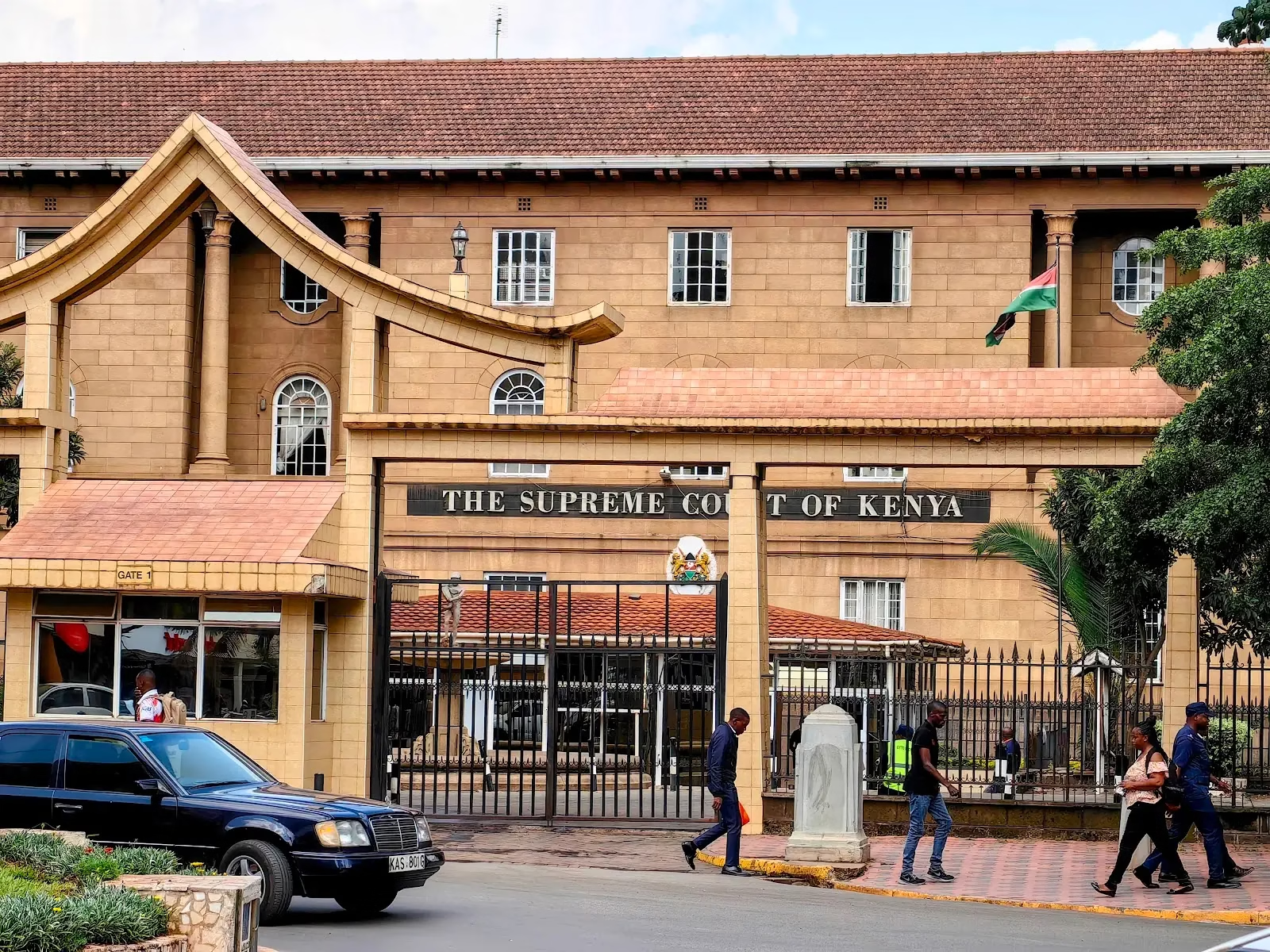
In Kenya, many legal battles begin quiet, with a tender notice pinned on a board, a bid submitted on time, and hope sealed in an envelope.
But sometimes, a tender becomes more than a procurement process. It becomes a test of the law itself.
That is what happened in Petition 39 of 2018 [2019] KESC, a case that travelled from a government tender room all the way to the Supreme Court of Kenya, raising one profound question:
When lower tribunals make decisions, are they bound by precedent in the same way courts are?
For lawyers, public bodies, bidders, and anyone who has ever questioned how justice flows through our institutions, this case offers a story worth telling.
A Tender, a Promise, and a Sudden Reversal
In April 2017, the Energy Regulatory Commission (ERC) advertised a tender for a critical national function: the marking and monitoring of petroleum products.
Among the bidders was SGS Kenya Limited, a firm with technical capacity and experience. After evaluation, SGS emerged as the lowest evaluated bidder. By June 2017, the process seemed complete. The prize was within reach.
Then came the turn. The ERC abruptly terminated the tender process. Not because of fraud. Not because of illegality. But because new technology had emerged and the technical specifications had changed.
For SGS, the message was devastating: You won, but the rules have changed. And so began a legal journey through Kenya’s justice system.
From Review Board to High Court to Court of Appeal
SGS first knocked on the door of the Public Procurement Administrative Review Board.
The Board dismissed the complaint.
They went to the High Court, seeking judicial review.
The High Court sided with SGS and ordered the ERC to proceed with the original award.
The ERC appealed. The Court of Appeal overturned the High Court’s decision, holding that the High Court had gone too far, that it had reviewed the merits of the procurement decision rather than just the process.
For many litigants, this is where the story would end. But for SGS, the question had grown bigger than a tender. They sought certification to go to the Supreme Court. And that is where the case changed character completely.
The Real Question: Are Tribunals Bound by Precedent?
The Court of Appeal certified the matter as one of general public importance.
Not because of petroleum.
Not because of procurement.
But because of this legal issue: Are tribunals and quasi-judicial bodies bound by the doctrine of stare decisis, the duty to follow binding precedent?
This question touches the heart of Kenya’s justice system. Every day, tribunals decide disputes in:
- Procurement
- Tax
- Labour
- Land
- Regulation
If tribunals are not bound by precedent, then:
- Similar cases may be decided differently
- Legal certainty is weakened
- Predictability in the law is lost
This was no longer just SGS’s fight. It was a fight about how justice is structured in Kenya.
The Supreme Court Steps In, Carefully
Before the full appeal could be heard, SGS asked the Supreme Court for a stay of execution, an order to stop the new tender process from moving forward. The Supreme Court agreed that:
- The case was properly before it
- The certified question was serious and important
But the Court refused to stop the tender process. Why?
Because the Supreme Court is not a court of convenience. It is a court of preservation, not interruption.
The judges emphasized a key principle: Stay orders exist to preserve the subject matter of an appeal, not to punish parties or reverse completed acts.
Since a new contract had already been signed, the Court found that:
- The appeal was still alive
- But no urgent conservatory orders were justified
The application was dismissed. Costs were left to await the final appeal. Quietly, the Court reminded litigants of a hard truth: Not every serious constitutional question entitles you to urgent relief.
Why This Case Matters Today
At first glance, this looks like a procurement dispute. It is not. This case matters because it speaks to:
1. The Authority of Tribunals
If tribunals are bound by precedent, then:
- Consistency becomes a legal duty
- Arbitrary decision-making is constrained
- The rule of law deepens
2. The Limits of Judicial Review
The Court of Appeal reminded us:
- Courts review process, not merits
- Judges are not procurement committees
This boundary protects both:
- Institutional competence
- Separation of powers
3. The Discipline of the Supreme Court
The Supreme Court showed restraint:
- Serious issues do not guarantee urgent orders
- Law must move carefully, not emotionally
In a system where every litigant seeks urgency, this discipline protects the Court’s authority.
A Human Story Behind the Law
Behind the citations and rulings is a human story: A company that believed it had won fairly. A regulator trying to modernize systems. Courts struggling to balance law, policy, and justice. And a legal system asking itself: How should power flow through our institutions?
This is what makes Petition 39 of 2018 more than a case. It is a mirror.
Final Reflection
In Kenya, the strength of the law is not measured only by bold judgments.
Sometimes, it is measured by restraint. By unanswered questions left for deeper hearing. By a Supreme Court that knows when to pause.
As the final appeal awaited hearing, one thing was already clear:
This case would shape how tribunals reason, how courts supervise, and how precedent breathes through our justice system.
At Legal Express Kenya, we believe these are the stories that matter.
Because in every tender, every tribunal, and every appeal, the future of the rule of law is quietly being written.


















Leave a Reply