



A Child Behind Bars: How This Case Reached the High Court
In December 2025, the High Court in Eldoret was asked to confront a reality that many Kenyans know exists, but few speak about openly: children living behind prison walls, not because they committed any crime, but because their mothers were sentenced to jail.
The case of RC v Republic [2025] KEHC 19189 came before Justice R. N. Nyakundi as a criminal application seeking review of a custodial sentence imposed by a Magistrate’s Court. What made this case different was not the offence itself, but the quiet presence of an innocent child whose life had been reduced to prison routines, metal doors, and locked gates.
When a Mother Is Sentenced, Who Really Pays the Price?
A prison sentence is meant to punish the offender. But in cases involving mothers with young children, the punishment often spills over, silently and unfairly, to those who had no part in the crime.
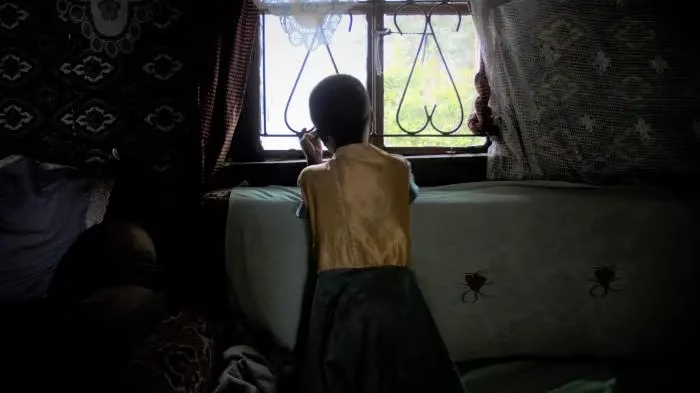
In this case, the applicant was incarcerated together with her child. That child did not stand trial. That child was not convicted. Yet, that child was deprived of freedom, safety, and a normal childhood.
The High Court was forced to ask a difficult question: is this justice, or is it convenience disguised as punishment?
The Silent Prisoners of Our Justice System
Children who accompany their mothers to prison become what this ruling implicitly exposes, silent prisoners.
They wake up in prison cells. They grow up within prison walls. Some are born there. Others spend their most formative years surrounded by conditions never meant for children.
Justice Nyakundi acknowledged this uncomfortable truth: that Kenya’s justice system, at times, has allowed innocent children to serve sentences they never deserved.
What the Constitution Demands When Children Are Involved
The Constitution of Kenya is clear and uncompromising when it comes to children.
Article 53(1) states that a child’s best interests are of paramount importance in every matter concerning the child. This is not a suggestion. It is a command.
The Court emphasized that sentencing decisions do not exist in isolation. Judges and magistrates must look beyond the offender and consider how their decisions affect vulnerable third parties, especially children.
Article 53 Explained: “The Child’s Best Interests” in Real Life
In simple terms, “the best interests of the child” means this: no decision should harm a child when there is a lawful alternative.
Justice Nyakundi explained that even when a parent has been lawfully convicted, the court must still ask:
- Will imprisonment harm the child?
- Are there non-custodial alternatives available?
- Can justice be served without destroying a child’s wellbeing?
If the answer points to harm, then the Constitution requires the court to choose a better path.
Why Prison Is No Place for a Child
The High Court did not mince words. Kenyan prisons are not designed for children.
They lack adequate daycare facilities, proper nutrition systems, safe play environments, and emotional support structures necessary for young children. Exposing children, some under the age of two, to prison life amounts to a failure of both law and humanity.
The Court noted that incarcerating children alongside their mothers violates not only the Constitution, but also the Children’s Act and international child protection standards.
The High Court Draws a Line
In a decisive moment, the Court made it clear: children must not be imprisoned for their mothers’ crimes.
Justice Nyakundi rejected the idea that incarceration should be automatic simply because a parent has been convicted. Instead, the Court insisted on deliberate, compassionate, and constitutionally compliant sentencing.
This ruling draws a clear line, one that trial courts across Kenya must now respect.
From Punishment to Compassion: Rethinking Sentencing in Kenya
This decision does not excuse criminal conduct. Rather, it recognizes that justice can punish wrongdoing without harming the innocent.
The Court reaffirmed that non-custodial sentences, such as probation and community service, are lawful, appropriate, and often preferable where children are involved, unless the offence is so serious that no alternative exists.
This marks an important shift from rigid punishment to balanced justice.
What the Judge Ultimately Ordered, and Why It Matters
The High Court reviewed the custodial sentence and substituted it with a non-custodial sentence supervised by a probation officer.
Crucially, the Court ordered the immediate release of the child from prison.
In doing so, the Court did more than alter a sentence, it restored a child’s freedom, dignity, and chance at a normal life.
This Ruling Is Bigger Than One Case.
Although this case involved one applicant and one child, its impact goes far beyond Eldoret.
It sets a clear precedent that:
- Trial courts must actively consider children’s rights during sentencing
- The welfare of children cannot be treated as an afterthought
- Convenience can never override constitutional duty
What This Decision Changes for Kenyan Mothers, Children, and Courts
For Kenyan families, this ruling offers hope.
For mothers, it means courts must now look at the whole picture, not just the offence.
For children, it affirms that the law sees them, protects them, and values their innocence.
For courts, it is a reminder that justice must always wear a human face.
Justice That Protects the Innocent
The ruling in RC v Republic reminds us that the strength of a justice system is measured not by how harsh it is, but by how wisely it protects the innocent.
In choosing the child over convenience, compassion over routine, and constitutional values over mechanical sentencing, the High Court reaffirmed a powerful truth:
Justice is not only about punishing crime, it is about preserving humanity. See the entire case file HERE
At Legal Express Kenya, we will continue to unpack decisions like this because the law should not only be understood, it should be felt, especially by those it exists to protect.
















Leave a Reply